AI will not remove humans from marketing
The future of marketing is not fully autonomous.
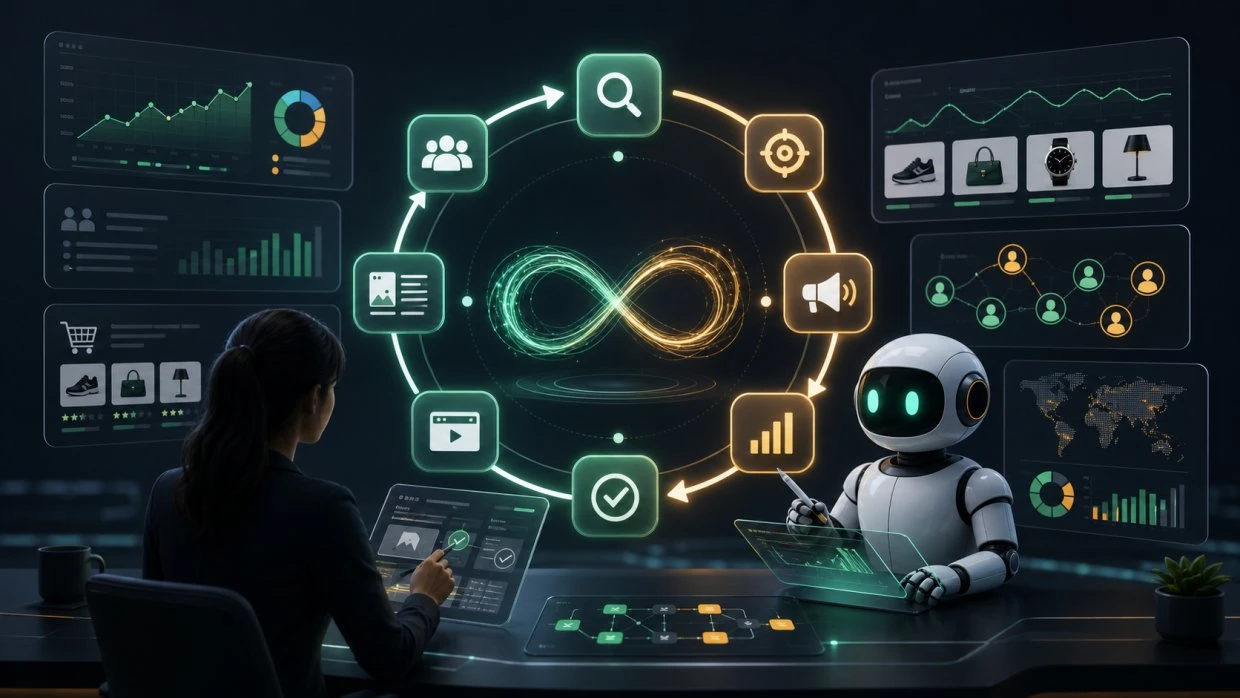
It is human-in-the-loop.
AI marketers will take on more work: research, trend discovery, content drafts, visual ideas, campaign setup, testing, reporting, and optimization. But the highest-value decisions will still need human judgment.
The goal is not to replace the marketer.
The goal is to make the marketer faster, more efficient, and more effective.
Marketing has too many moving parts
Modern marketing teams are overloaded.
A single campaign can require market research, audience selection, copywriting, visual production, landing pages, paid media, SEO, AEO, GEO, reporting, attribution, and follow-up experiments.
Most teams do not fail because they lack ideas.
They fail because execution is slow, fragmented, and expensive.
This is where AI marketers change the operating model.
AI should handle the repetitive work
A good AI marketer should remove operational drag.
It should help with:
- Finding trends and market signals
- Drafting content angles
- Creating first-pass copy
- Generating visual concepts
- Preparing campaign variations
- Monitoring performance
- Summarizing what changed
- Suggesting the next action
These tasks are important, but they often consume too much human time.
When AI handles the first 70 percent of the workflow, humans can spend more time on strategy, taste, judgment, positioning, and decisions.
Humans should stay in the decision loop
Marketing still needs human judgment.
AI can suggest which trend is rising. A human decides whether it fits the brand.
AI can draft ten angles. A human chooses the one that feels sharp, credible, and differentiated.
AI can recommend budget movement. A human decides whether the risk is acceptable.
AI can summarize performance. A human decides what the result means for the business.
That is the right division of labor.
AI executes and analyzes.
Humans direct and decide.
The best teams will become faster
Human-in-the-loop marketing is not slower because humans are involved.
It is faster because humans are involved at the right points.
Instead of manually building every asset from scratch, teams can review stronger first drafts. Instead of waiting days for reporting, they can see what changed quickly. Instead of guessing the next test, they can evaluate AI-generated options.
The speed advantage comes from compressing the work between idea and action.
The best teams will become more efficient
Efficiency does not mean producing more low-quality content.
It means reducing wasted work.
AI can help teams avoid blank-page time, duplicated analysis, slow creative iteration, and scattered campaign setup. It can turn messy inputs into usable options.
That allows smaller teams to operate with more leverage.
A lean marketing team with an AI marketer can move like a much larger team.
The best teams will become more effective
Speed and efficiency are not enough.
The real goal is effectiveness.
AI marketers become powerful when they connect execution with outcomes. They should not only create content. They should learn which content drives attention, which campaigns convert, which products resonate, and which signals improve revenue.
This is why commerce context matters.
Marketing is not only about generating assets. It is about moving demand toward conversion.
Aeris is built for this model
Aeris is designed as an AI marketer for the human-in-the-loop era.
It helps marketers find what is happening, create what is needed, launch faster, and improve based on performance signals.
But the human remains in control.
The marketer sets the direction.
Aeris accelerates the work.
The takeaway
The future of marketing is not human versus AI.
It is human with AI.
The companies that win will not remove people from the loop. They will put people at the highest-leverage points in the loop.
AI will help marketers do more.
But more importantly, it will help them do better.