
Claude Skills for SEO: What AEO and GEO Teams Should Build Next
John Ahn
Aeris Editorial
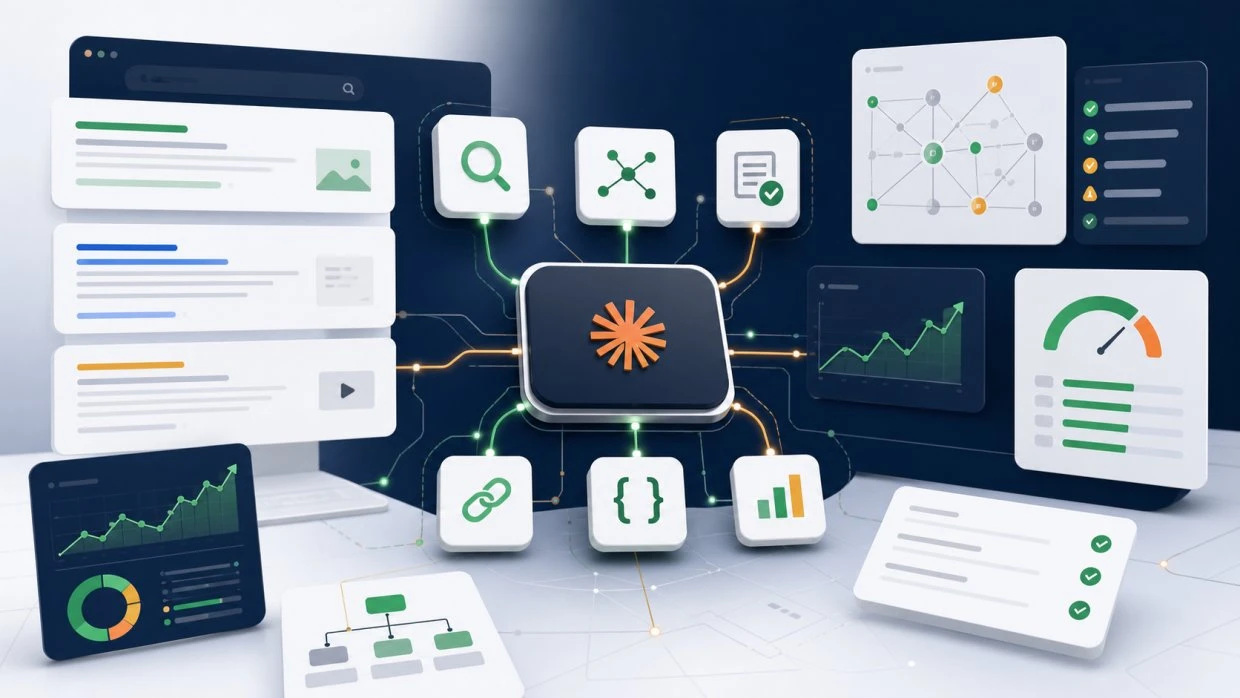
Claude Skills are a useful signal for where SEO is going
Claude Skills are not just another productivity feature. For SEO teams, they point to a bigger shift: repeatable search workflows are becoming modular, portable, and agent-ready.
A recent set of free SEO Skills from Vicky Lalwani shows how practical this can get. The list covers on-page SEO, Google Search Console, Semrush, technical audits, robots.txt, sitemaps, keyword clustering, backlinks, and even GitHub visibility.
That matters because most SEO work is not one big magical insight. It is a sequence of repeatable checks:
- Rewrite weak titles and meta descriptions
- Find missing topics compared with top-ranking pages
- Detect orphan pages and suggest internal links
- Generate valid JSON-LD schema
- Identify keyword cannibalization
- Surface pages with ranking potential but low CTR
- Pull quick wins from Google Search Console
- Fix indexing, sitemap, robots.txt, and technical errors
Skills turn those workflows into reusable operating units.
From SEO to AEO and GEO
Traditional SEO asks: can Google crawl, understand, rank, and show this page?
AEO, or Answer Engine Optimization, asks a different question: can an answer engine extract, trust, and cite this page when users ask direct questions?
GEO, or Generative Engine Optimization, goes one step further: can generative AI systems understand your brand, products, data, and authority well enough to recommend you inside synthesized answers?
This is why Claude Skills are interesting. A meta optimizer is useful for SEO. But the same structure can become an AEO skill that rewrites pages into clearer question-and-answer blocks. A schema generator is useful for Google. But it can also become a GEO skill that strengthens entity clarity, source attribution, and product facts.
The workflow does not disappear. The target changes.
The SEO stack is becoming agentic
The old SEO stack was tool-driven. Teams logged into Search Console, Semrush, crawlers, CMS platforms, and analytics dashboards.
The new stack is becoming agent-driven. Instead of asking a person to manually move between tools, an agent can read the workflow, connect the data source, run the check, and propose the fix.
That changes the operating model.
A content team can ask:
- Which pages are ranking but under-clicked?
- Which articles are missing the entities competitors mention?
- Which pages should be connected through internal links?
- Which products need schema cleanup?
- Which FAQ blocks should be added for answer engines?
- Which pages are likely invisible to AI shopping agents?
The output is not just a report. It is an action list.
What SEO teams should build next
If you already use SEO tools, the next step is not replacing them. The next step is wrapping your best workflows into repeatable AI skills.
Start with five high-leverage skills:
1. AEO page rewriter
Convert existing pages into answer-friendly structures. Add clear definitions, concise answers, FAQ sections, and source-backed explanations.
2. GEO entity optimizer
Audit whether your page clearly identifies the brand, product category, use case, audience, alternatives, pricing signals, and proof points.
3. Internal authority linker
Find pages that should support each other by topic, funnel stage, and commercial intent.
4. Schema and facts validator
Check structured data, product facts, organization data, author information, and FAQ schema before publishing.
5. AI citation monitor
Track whether your brand appears in ChatGPT, Claude, Perplexity, Gemini, and other answer surfaces for commercial queries.
The real opportunity
Claude Skills for SEO are useful because they reduce manual work.
But the bigger opportunity is strategic: they show how search work becomes programmable.
SEO used to be about optimizing pages for blue links. AEO is about being extracted into answers. GEO is about being understood by generative systems. Commerce media adds one more layer: turning that visibility into measurable revenue.
The teams that win will not simply publish more content. They will build repeatable systems that help AI understand, trust, cite, and convert their pages.
That is where SEO is going next.